
CLOSING
CONFERENCE
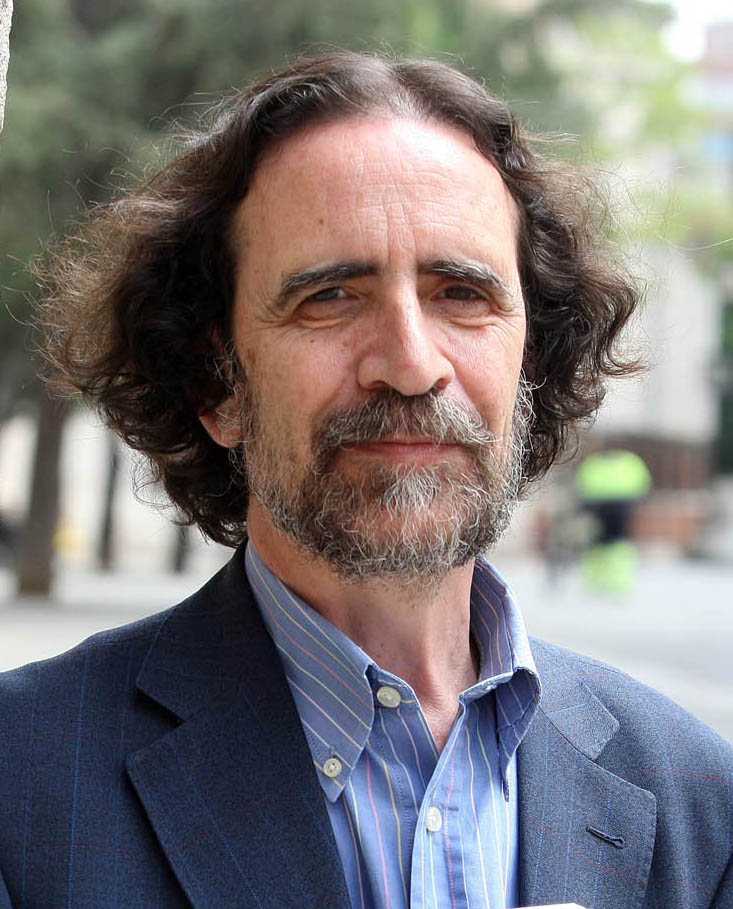
LUIS DÍAZ VIANA
Consejo superior de Investigaciones Científicas (CSIC)-Universidad de Valladolid (UVa)

Friday, September 4, 2026
Aula Romeros
1:30 p.m. to 3:00 p.m.
Doctor of Philology and anthropologist, honorary professor at the Institute of Language, Literature, and Anthropology of the Center for Human and Social Sciences of the Spanish National Research Council (CSIC), as well as honorary director of the Chair of Intangible Cultural Heritage at the Institute of European Studies at the University of Valladolid. He has been Professor of Social Anthropology at the University of Salamanca, Associate Researcher at the Department of Anthropology at the University of California, Berkeley, and visiting professor at various American universities such as Los Angeles (California) and Austin (Texas), as well as Mexican universities such as the UNAM. President of the Castile and León Anthropology Association, he is a member of several committees of journals in his field, such as Disparidades, and has been a member of the Fulbright Commission and the Standing Committee for Humanities of the European Science Foundation.
Editor of important collections of short stories, romances, and popular legends from Spain, he has published more than one hundred individual and collective works, many of them dedicated to the anthropological reality of Castile and León; and, in coordination with Dámaso J. Vicente, El patrimonio Cultural Inmaterial de Castilla y León (The Intangible Cultural Heritage of Castile and León) (2016). He has been recognized with various distinctions, such as the Castilla y León Prize in Social Sciences and Humanities, the Ministry of Culture’s “Marqués del Lozoya” National Prize for Cultural Research for the best article, and the “Ciudad de Salamanca” Novel Prize for Los últimos paganos (The Last Pagans). For decades, he has been engaged in pioneering work on new narratives of the contemporary world, such as Los guardianes de la tradición y otras imposturas acerca de la cultura popular (The Guardians of Tradition and Other Impostures about Popular Culture) (2019) and El regreso de los lobos. La respuesta de las culturas populares a la era de la globalización (The Return of the Wolves: The Response of Popular Cultures to the Age of Globalization) (2003), Narración y memoria: anotaciones para una antropología de la catástrofe (Narration and Memory: Notes for an Anthropology of Catastrophe) (2008), and Miedos de hoy. Leyendas urbanas y otras pesadillas de la sobremodernidad (Fears of Today: Urban Legends and Other Nightmares of Hypermodernity) (2017).
Resistance from otherness: intangible heritage and collective property rights
This lecture will explore the significant connection between three categories of otherness: indigenous peoples, peasants, and immigrants. It will also analyze the impact of these categories on how national and international institutions treat the members of these groups and their cultures, as well as on their respective legislations. This, as can be assumed, has a very direct effect on the concepts, terms, and approaches that affect the idea of what is considered intangible cultural heritage and its management, since UNESCO established the declaration for its safeguarding in 2003. This is because these categories point to or single out groups and populations that are placed a priori in a disadvantaged situation that could be summarized as follows: they would be people without history, names, or rights. However, this is an “invention” that historically refers to various previous denominations, such as barbarians, pagans, and savages.
The name “pagans” comes from the name given in the ancient world to those who, in the countryside, or more specifically in the mountains and forests, worshipped and paid homage to their gods. And it is for this reason that when Europeans arrived in the New World, preachers and chroniclers tended to equate the ancient idolaters with the new ones. The subsequent “ethnographic invention” was served. Why were indigenous people and peasants not seen as “us” and should they be re-educated until they resembled us as closely as possible? For a number of reasons that make them hypothetical “savages from here and there”: they usually live in the countryside, far from the “civilized world,” which is ‘ours’; because of their closeness to nature and the “wild,” they are suspected of remaining outside the religion and laws of “civilized people”; they live off agriculture and herding, as our ancestors did; they tend to preserve beliefs, practices, and rituals from other times; they sometimes insist on continuing to live in this way without joining in with supposed technological and industrial progress. Therefore, if there is no way to “recover” them for the progress of “today’s society,” they would be, from the perspective of various powers, unnecessary and expendable.
However, the Western view of the “savages over there” was not always—and in all respects—so unbearably ethnocentric. As Graeber and Wengrow have explained, there were Europeans, mainly belonging to certain religious orders, who discovered in the peoples of the New World the persistence of customs and social organizations that they considered desirable: a kind of utopia come true that could be perfected without having to resort to transforming the members of those societies into Europeans. These priests and friars had discovered and described certain peoples who, while not absolutely ideal in their behavior, were based on the organization of communities that were more egalitarian and respectful of their members than European societies. And they had a decisive influence, through their works, on Western thinkers of the so-called Age of Enlightenment to embrace, among other objectives, “equality” as a goal, which until then had not been a principle governing European societies, built on a clear structure or order of lords and serfs.
For all these reasons, we present this proposal for reflection and debate on the idea of cultural heritage, based on the reconceptualization and defense of human rights from an anthropological, historical, and legal perspective. Because it is also a reality that, even though the “ethnographic invention” mentioned above was a strategy to occupy territories, dominate peoples, and convert “the others” into something more like ‘us’ or deny them their humanity, it is no less true that peasants, indigenous peoples, and immigrants can today become “the same”; and, as “others” who are constructed as such, they may be stigmatized or dispossessed of their cultures and the rights inherent to their human condition. Hence, it depends on the application and use given to a construct such as Intangible Cultural Heritage whether it functions as yet another expropriation of the knowledge of “others” or as a true recognition of their cultures and a vehicle for resistance.